What Is This Resource?
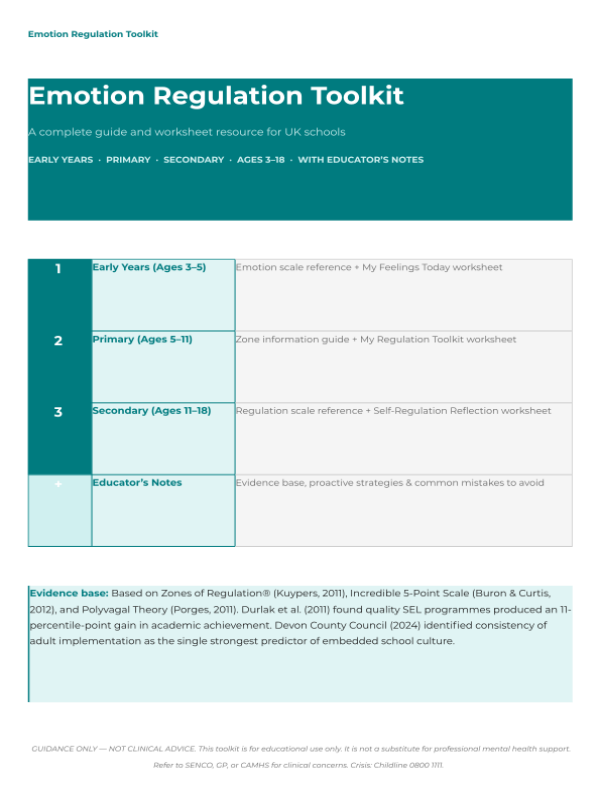
The Emotion Regulation Toolkit is a 19-page, age-differentiated resource for UK schools covering the full span from Early Years (ages 3–5) through to secondary (ages 11–18). It provides educators with both the theoretical grounding and the practical tools to teach emotion regulation as a universal, daily skill - not merely a reactive response to distress. The toolkit is organised into three curriculum modules, each with a reference scale, educator guidance, and a printable student worksheet, plus a dedicated Educator's Notes section that consolidates the evidence base, proactive implementation strategies, and common mistakes to avoid.
The resource draws on three well-established frameworks: the Zones of Regulation (Kuypers, 2011), the Incredible 5-Point Scale (Buron and Curtis, 2012), and Polyvagal Theory (Porges, 2011). Each module presents a five-zone emotion scale adapted to the developmental language and body-awareness capacity of the relevant age group. The worksheets - My Feelings Today (EYFS), My Regulation Toolkit (primary), and Self-Regulation Reflection (secondary) - guide pupils through identifying their current emotional state, mapping physical body clues, selecting regulation strategies, and reflecting on patterns over time.
How to Use It
Educators are strongly advised to read the Educator's Notes section before introducing any module to pupils, as this section explains both the implementation principles and the common pitfalls that undermine the tool's effectiveness. The single most important instruction in the resource is to introduce the scale during calm, settled moments - not during a crisis - so that it becomes associated with self-awareness rather than with distress or punishment.
Each module includes suggestions for proactive check-in routines: a morning arrival check-in (pupils indicate their zone number on their fingers or a card), a post-lunch reset activity, pre-task priming before challenging work, and an end-of-day exit slip. Adult modelling is emphasised throughout as the highest-impact action staff can take - openly sharing their own zone number and chosen strategy normalises emotional language for pupils of all ages. For secondary students, the toolkit recommends framing regulation as a performance skill used by athletes and professionals, rather than as a mental health tool, to reduce stigma and increase engagement. The resource notes that cultural embedding typically takes 12 to 18 months of consistent use.
Who It Is For
The toolkit is written for school staff across all phases - from nursery practitioners and primary class teachers to secondary form tutors, pastoral leads, and SENCOs - and is designed to be used as a whole-school resource rather than a targeted intervention for individual pupils. Because the framework is built on universal principles of neurological development, it is relevant for all children, not only those with identified SEMH or SEND needs.
The resource will be of particular value to schools looking to create a shared emotional vocabulary across staff and pupils, to settings implementing trauma-informed or attachment-aware practice, and to those seeking an evidence-based approach to reducing behaviour incidents and improving learning readiness. The secondary module will resonate with schools working with young people who are resistant to mental health framing, as its emphasis on neuroscience and performance offers a non-stigmatising entry point. SENCOs, counsellors, and school mental health leads will find the Educator's Notes section especially useful for planning whole-staff CPD and for advising colleagues on consistent implementation.