What Is This Resource?
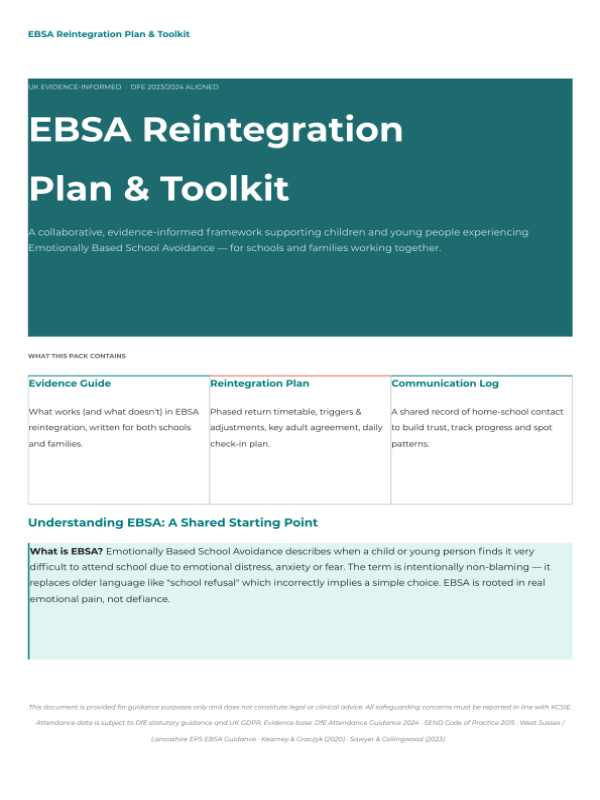
The EBSA Reintegration Plan and Toolkit is a 24-page, evidence-informed framework designed to support children and young people experiencing Emotionally Based School Avoidance (EBSA) - a recognised condition in which genuine emotional distress, anxiety, or fear prevents regular school attendance. The resource is explicitly non-blaming in its approach, deliberately moving away from outdated language such as "school refusal," which implied choice or defiance.
Aligned with DfE Attendance Guidance (2024), the SEND Code of Practice (2015), and drawing on research by Kearney and Graczyk (2020) and Sawyer and Collingwood (2023), the toolkit contains three main components: an Evidence Guide (available in separate school and family versions), a detailed Reintegration Plan with a phased return timetable and trigger identification section, and a Home–School Communication Log. A quick-reference summary page brings together the key principles for daily use by both staff and families. The plan culminates in a signature agreement page involving the key adult or SENCO, the parent or carer, and, where appropriate, the young person themselves.
How to Use It
The toolkit is designed to be completed collaboratively - not by school alone, and not in a single sitting. It should begin with all parties reading the relevant Evidence Guide (school staff read the school version; families read the family version), which sets out what works, what does not, and why. From there, the Reintegration Plan is filled in together across a meeting, identifying the young person's known triggers, the school adjustments that will be put in place, and the named key adult who will lead on day-to-day support.
The phased return timetable spans four stages - from very brief, low-pressure contact in Phase 1 through to a full timetable with agreed adjustments in Phase 4 - and is explicitly paced to follow the young person's readiness rather than a fixed timeline. The Communication Log should be updated after every significant contact between school and family, creating a shared, transparent record that builds trust and helps identify patterns. Review meetings should be scheduled at agreed intervals, with the plan amended freely as circumstances change. Both school and family receive their own copy of the relevant sections.
Who It Is For
The toolkit has been designed for use by schools - particularly SENCOs, pastoral leads, and attendance officers - and families in equal measure, recognising that EBSA cannot be resolved by school action alone. It is relevant across all age groups and school phases, with particular relevance at key transition points such as the move to secondary school, where EBSA rates are known to peak.
The resource is especially pertinent for children and young people who are autistic, have unmet SEND needs, or present with SEMH difficulties, as these groups are disproportionately affected by EBSA. It will also be valuable for local authority professionals, educational psychologists, Early Help practitioners, and CAMHS teams who are involved in supporting a young person's reintegration. Families who feel blamed or overwhelmed by their child's non-attendance will find the family-facing sections particularly supportive, as they are written with empathy, clarity, and an explicit acknowledgement that EBSA is not a parenting failure.