What Is This Resource?
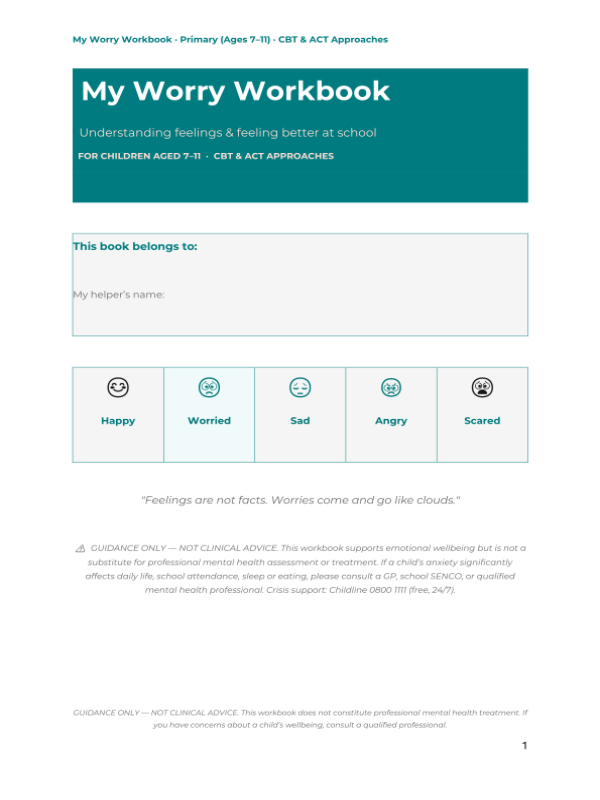
The Anxiety and Worry Workbook is a 25-page dual-stage workbook that supports children and young people in understanding and managing anxiety, drawing on two of the most extensively researched therapeutic approaches: Cognitive Behavioural Therapy (CBT) and Acceptance and Commitment Therapy (ACT). The workbook is split into two distinct parts within the same document - a primary version for children aged 7–11 (My Worry Workbook) and a secondary version for young people aged 11–16 (My Anxiety and Wellbeing Workbook). Each version follows a parallel five-section structure covering feelings identification, a worry thought log, evidence-based thought investigation, a personal coping plan, and a circle of control exercise. The primary version uses age-appropriate language, visual prompts such as a worry thermometer, and simple CBT detective framing, while the secondary version introduces more sophisticated concepts including cognitive distortions, gradual exposure (the worry ladder), and ACT-based defusion and values work.
How to Use It
The workbook is explicitly designed to be used alongside a trusted adult rather than completed independently. The adult-facing guidance at the start of each section sets out clear dos and don'ts - for example, validating feelings before offering solutions, keeping sessions to 10–20 minutes, and avoiding excessive reassurance, which is known to maintain rather than reduce anxiety. In the primary section, children work through identifying feelings in their bodies, logging worries with a size rating, investigating those worries using guided questions (the Thought Detective framework), building a calm-down toolkit with Star Breathing and 5-4-3-2-1 grounding, and identifying what they can and cannot control. In the secondary section, young people are introduced to named cognitive distortions such as catastrophising, mind reading, and emotional reasoning, then guided through a five-step structured thought investigation. The worry ladder in the coping plan section introduces the principle of gradual exposure - the evidence-based approach of facing feared situations in small, manageable steps. Both versions include a crisis signposting plan directing young people to Childline (0800 1111) or emergency services.
Who Is It For?
The primary section is intended for children aged 7–11 experiencing school-related worries including test anxiety, friendship difficulties, transitions, separation anxiety, and fear of getting things wrong. The secondary section addresses the same themes at greater depth, adding exam pressure, social anxiety, and uncertainty about the future as key concerns for young people aged 11–16. Both sections are suitable for use by a wide range of supporting adults - including teachers, TAs, pastoral staff, school counsellors, learning mentors, and parents or carers - in either a school or home setting. The workbook is psychoeducational in nature and is not a substitute for clinical assessment or treatment. It is most effective as a first-line, preventative, or early-intervention tool for children whose anxiety is manageable but affecting daily life, rather than for those in acute crisis or with complex, long-standing mental health difficulties. Where anxiety is significantly affecting school attendance, sleep, eating, or relationships, the workbook itself directs adults to seek professional support via the school SENCO, GP, or CAMHS.