What is in this PDF?
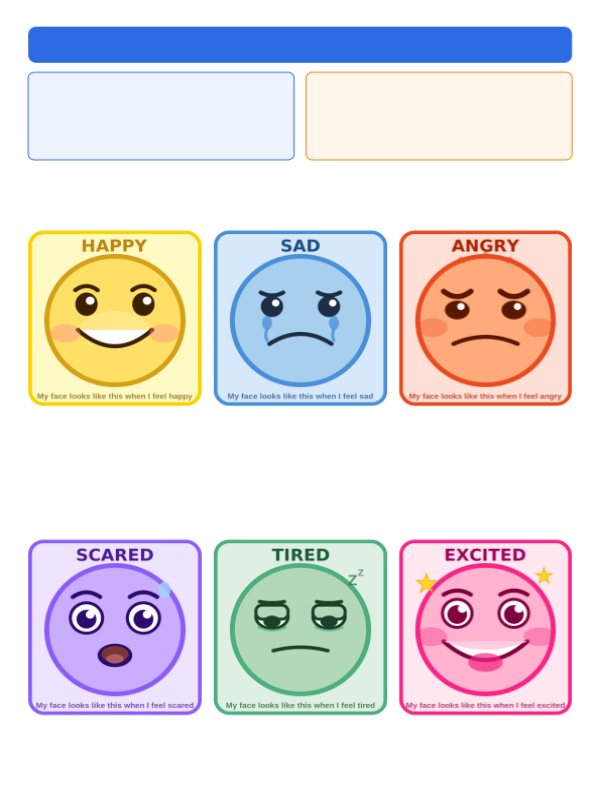
This PDF contains six emotion cards designed to support emotional literacy in young children. Each card features a bold, colour-coded cartoon face representing one of six core emotions: happy, sad, angry, scared, tired, and excited. The faces are drawn in a simple, ARASAAC-compatible style, using clear lines and exaggerated expressions so that each emotion is immediately recognisable at a glance. Every card displays the emotion word in large, uppercase text, and includes a short first-person prompt - "My face looks like this when I feel..." - to help children connect the image to their own experience. The colour palette is carefully chosen to match the mood of each emotion: warm yellow for happy, calm blue for sad, bold red-orange for angry, soft purple for scared, gentle green for tired, and vibrant pink for excited. All six cards are laid out on a single A4 sheet, ready to print, laminate, and cut.
Who is this for?
These cards are designed primarily for children aged five to seven who are autistic or have communication and language support needs, in a UK primary school setting - particularly within SEN, EYFS, or KS1 provision. They are especially useful for children who find it difficult to identify, name, or communicate their emotions verbally, whether due to autism, developmental language disorder, anxiety, or other additional needs. The cards can also be used more broadly across a whole class as part of an emotional literacy or PSHE programme, and are suitable for use at home by parents or carers who want to support their child's emotional vocabulary. Teaching assistants, SENCOs, and early years practitioners will find them straightforward to introduce without specialist training.
How should these cards be used?
Print the sheet on standard A4 paper, laminate it, and cut the cards apart individually. They can be stored on a key ring for easy access, displayed on a classroom feelings board, or kept on a child's desk as a quiet, unobtrusive communication tool. The most effective way to introduce them is during calm, regulated moments rather than in the middle of a difficult episode - show the child each card, name the emotion together, and talk briefly about when they might feel that way. Once familiar, use them at natural check-in points: at the start of the school day, after lunch, or during transitions. Ask the child to point to or hand over the card that matches how they feel. Pair the cards with a simple sentence frame such as "I feel ___ because ___" to gently extend communication. Over time, they can support self-regulation, help adults respond more effectively to a child's needs, and build the emotional vocabulary children need to navigate both school and everyday life.